Setting the constraints
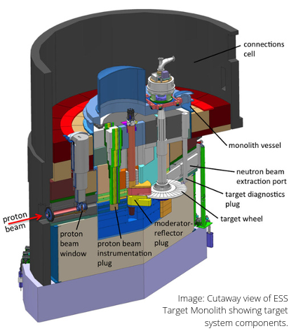
At ESS, the neutron-production performance depends strongly on having hydrogen at roughly 18 K directly in the MRP moderator. The second refrigeration loop, the helium loop is used as the cold sink and removes the heat from the hydrogen through a heat exchanger. The MRP plug has many elements to integrate, all competing for space: hydrogen piping, water channels, reflector material, vacuum/insulation structures and neutron beam openings. This brings a great engineering challenge to the Helium loop that must cool the hydrogen with a high efficiency. The overall ESS Target concept, including the MRP Plug is shown in figure 1.
From physical challenge to engineered solution
The ESS cooperation model relies on in kind contributions from Member States. CVR (Research Centre Řež), a leading Czech research and engineering organization with extensive expertise in advanced energy technologies, designed and delivered the ESS target's high-temperature helium cooling system as a complete engineering package, including manufacturing, testing and commissioning support.
CVR engineered the closed helium loop for the MRP to operate at pressures of up to 11.4 bar and flow rates approaching 3 kg/s. Within this framework, CVR contacted MECOS AG in Switzerland to provide the two high-speed helium compressor stages that must run at an extreme rotation speed, up to 40’000 rpm, delivering approximately 170 kW of shaft power per unit. These operating conditions define the scale and complexity of the system and highlight the importance of reliable system integration, precise rotor control, and long-term operational stability. Ensuring stable operation requires far more than conventional cooling. It demands a precisely controlled, fully integrated solution.
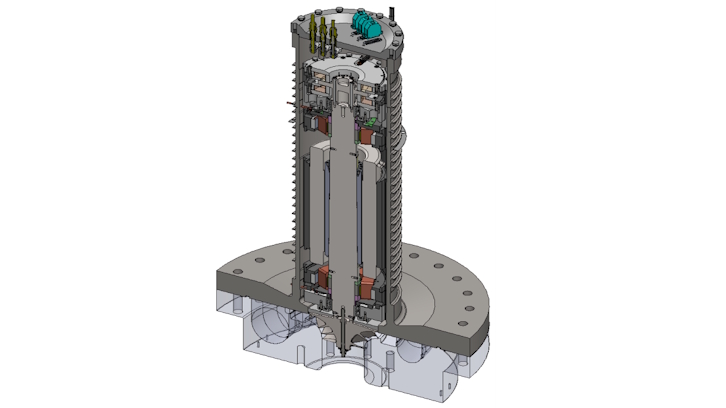
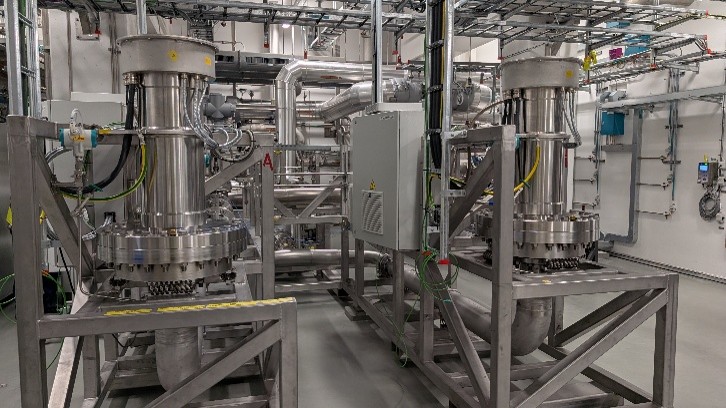
The high speed compressor design including active magnetic bearings is shown on Figure 2. The two compressor units installed in the Target hall at ESS are shown on Figure 3.
|
|
Precision under extreme conditions
Operating at these performance levels demands exceptional control of both thermodynamics and rotordynamics. The system must maintain stable operation across a wide speed range while avoiding critical resonances. Advanced monitoring systems continuously detect rotor imbalance, vibration and other abnormal operating conditions.
MECOS AG’s active magnetic bearing technology enables contact-free rotor operation with highly precise positional control. By levitating the rotor without mechanical contact at the bearings, the technology eliminates bearing-related mechanical wear, reduces maintenance requirements and supports long-term operational stability and reliability. At the same time, the fully hermetic design prevents helium leakage and protects against contamination – a key requirement in a system that must remain clean and reliable over extended operating periods.
The absence of oil or grease is equally critical. Using oil-free compression technology, the helium circuit remains entirely clean, avoiding additional filtration and reducing system complexity while increasing reliability.
Integrated systems and strong partnerships
The helium cooling system is not a standalone unit but an integral part of the process. It is directly connected to the control architecture, enabling continuous monitoring, precise control, and automated protection. This allows stable operation with minimal human intervention, even in a highly controlled environment.
Equally important is the collaboration behind the solution. The established partnership between CVR and ESS provides a strong foundation of trust and technical alignment. MECOS complements this structure with expertise in hermetic system design and integration, ensuring that all components perform together as a coherent system.
The complete moderator system assembled by Forschungszentrum Jülich in Germany was officially delivered to the ESS site in Lund in September 2026, marking a key milestone in the transition to the operational phases of the world's most powerful neutron source.
Engineering reliability for a critical research infrastructure
Projects such as ESS demonstrate that scientific excellence depends on reliable industrial execution. They show how specialized engineering companies and strong partnerships enable Europe to realize complex, high-performance infrastructure.
At the same time, the technologies applied here – hermetic systems, oil-free compression, high-speed turbomachinery, and magnetic bearings – are highly relevant across industries where purity, efficiency, and reliability are essential.
The helium cooling system for the ESS target wheel is therefore more than a technical solution. It is a clear example of how extreme physical requirements can be translated into robust, scalable engineering.

About MECOS AG

MECOS is a Swiss engineering company specializing in magnetic bearing systems and high-performance rotating machinery for demanding applications. The focus lies on solutions where precision, reliability, and long-term stability are essential.
With strong expertise in active magnetic bearing technology, MECOS develops integrated system solutions combining high-speed rotating equipment, advanced control systems, and application-specific engineering. Magnetic bearings enable contact-free operation, eliminating mechanical wear while ensuring precise control even under extreme conditions.
A key differentiator is MECOS’ system-level approach. The company does not simply deliver components but designs complete, fully integrated solutions, ensuring that mechanics, control, and application requirements perform as one.
MECOS works with industrial partners and research institutions across Europe, contributing to projects where performance and reliability are mission-critical.

Adrian Wyss
Head of Sales
MECOS AG
Zurich – Switzerland